
Accra, Ghana — 17 July 2026. The West Africa Centre for Agribusiness and Apiculture Development (WACAAD) has officially launched the Ghana HiveHoney Certification Mark, a new quality and traceability identity designed to restore consumer confidence in Ghanaian honey and support the sector’s return to premium export markets, including the European Union.
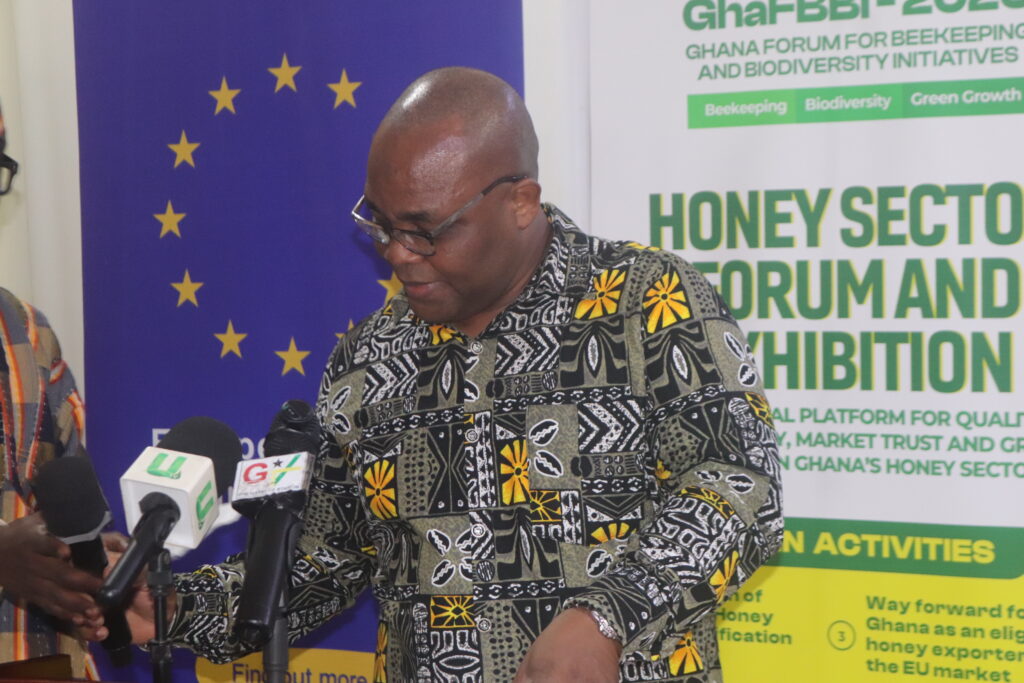
The mark was unveiled at the close of the Ghana Forum for Beekeeping and Biodiversity Initiative (GhaFBBI 2026), held on 14–15 July at the CSIR-Food Research Institute in Shiashie, Accra, under the theme “Beekeeping, Biodiversity and Green Growth.” The launch was supported by the European Union Delegation to Ghana and brought together beekeepers, processors, regulators, researchers and development partners for two days of technical sessions and policy dialogue.
A Collective Mark, Not Just a Logo
The Ghana HiveHoney Collective Mark has been registered with the Ghana Intellectual Property Office at the Registrar-General’s Department since 2025. For public communication at GhaFBBI 2026, it was presented as the HiveHoney Certification Mark, while its underlying legal and governance structure remains that of a collective mark system.
Presenting the mark, Dr. Courage Komla Besah-Adanu, Lead Consultant at WACAAD, described it as a shared commitment among value-chain stakeholders to agreed production standards and practices, rather than a simple brand asset. A representative of the Ghana Standards Authority (GSA) confirmed that the mark operates as a voluntary, private-sector certification that complements — rather than replaces — statutory oversight from the GSA and the Food and Drugs Authority (FDA), and used the occasion to signal that Ghana’s national honey standard, unchanged since 2015, is now due for review.
Why the Mark Matters Now
Ghana’s honey sector has long faced structural constraints: adulteration risk, inconsistent traceability, and residue-compliance gaps that have made it difficult for compliant producers to distinguish themselves from the rest of the market. The country currently sits outside the list of nations authorised to export honey to the European Union, a setback tied to concerns over its residue-management systems.
Speaking on the significance of the launch, Dr. John Kojo Ahiakpa, Executive Director of WACAAD, said the mark was intended to help place verifiably safe, traceable Ghanaian honey on shelves at home and abroad, describing it as part of a broader effort to build a sector defined by integrity and sustainability. EU Ambassador to Ghana, H.E. Rune Skinnebach, added that the partnership was about supporting traceability and sustainability work that would help Ghanaian products meet EU market requirements, opening new export opportunities and strengthening the private sector.

From Launch to Compliance Tool
WACAAD has been explicit that the mark is not intended as a ceremonial gesture. Producers, processors and marketers who adopt it will be introduced to a defined set of rules of use, eligibility criteria, hygiene expectations and documentation disciplines — including batch-level traceability and anti-adulteration safeguards — designed to convert the mark into a practical compliance-support tool rather than a purely promotional one.
An authorised-user registration process is now planned for beekeepers, aggregators, processors and packers who wish to adopt the mark, alongside a compliance-support package covering harvesting, handling, moisture control, storage and recall readiness. A dedicated technical committee is expected to oversee standards, monitoring and training as the mark moves from launch into implementation.
Part of a Bigger Market-Access Push
The HiveHoney launch was one strand of a wider roadmap presented at GhaFBBI 2026 by Dr. Ahiakpa, which also called for a single government agency to lead the sector long-term, a review of the 2015 national honey standard, a centralised digital database of laboratory-tested production data, a “single testing” model to reduce duplicated quality checks, and stronger producer cooperatives backed by shared processing infrastructure.
Representing the Food and Agriculture Organisation (FAO), Mr. Clifford Adagenera congratulated WACAAD on the initiative and pledged continued technical support through FAO’s Forest and Farm Facility to advance sustainable beekeeping and climate-resilient livelihoods in Ghana.
WACAAD says the coming months will focus on onboarding early adopters of the HiveHoney mark, finalising the traceability toolkit, and working with the GSA, FDA and Veterinary Services Directorate to align the mark’s standards with the technical requirements of premium export markets.
This action is funded by the European Union. Its contents are the sole responsibility of WACAAD and its partners and do not necessarily reflect the views of the European Union.
Media Contact: West African Centre for Agribusiness and Apiculture Development (WACAAD) — Williams Clinton Appoh, Email: info@wacaad.org, Phone: +233 020 836 1932.